Showing posts with label Rough Trade School. Show all posts

Thursday, September 30, 2010

I Lathe You

I finished turning my first table leg last night. Like several other skills and techniques I have learned in the wood shop, this one is not at all transferable to my later life. But, lathing is rather therapeutic. Unlike other stations in the shop, lathing does not permit one to help others loading their boards into and out of the planer or table saw. It requires a very near focus, specifically on the visible edge of your working piece. Slow, gentle, and repetitive movements are required to avoid introducing flaws. And, it only involves one round of sweeping (vacuuming, even!) at the end of the night.

Like the wide belt sander, it is apparently magical. It transforms one ugly, ungainly wood product into something you might actually buy, or at least bring into the house. Unlike the wide belt sander, the lathe requires a lot of participation from the operator. Oh, and it's a bit dangerous!

While experimenting with the skew chisel, I jammed it into the line where two boards are glued together, and a two-inch chunk of wood flew into my face and impaled my cheek. Now, that sounds much gorier than it really was. It did stick into my face. I did have to pull it out. But, the damage was only three tiny cuts. From the evidence that remains, you'd never guess what happened.

But without further ado: here is my first table leg, along with a reminder of its improbable origins!

16 boards, glued together in stacks of four, and clamped overnight.
Drumroll please . . .

The octagonal chunk at the bottom will be sawed off.
The octagonal chunk at the top stays in place,
and affixes the leg to the table beneath the "skirt."
It was hard to design this piece for several reasons. One reason is that the instructor had me build my legs out of four pieces of 2x6 glued together, which makes them much more massive than ordinary legs. In fact, all the other students in the class are using three pieces of 2x6 lumber glued together. Another reason it was difficult is that I didn't want to go for a lot of ornament, certainly not a lot of "country kitchen" style knobs and spools. No other table in our house has turned legs, and certainly not ornate legs.

So, in order to keep things streamlined, modern, and fine, I decided on a design inspired by my puppy's hind legs, which I find very elegant. Springy, strong, and delicate all at once, with pretty and proper little toes. See?
Not exactly illustrative, but darn cute!

Thursday, September 16, 2010

Clip: Bored

The past two weeks have revealed that the hundreds of half-empty boxes of nails and bottles of glue are not the extent of disorganization in the workshop. With some 19 students remaining in the class, there are numerous projects happening, all along the same approximate timeline. This has created serious bottlenecks, first for the jointer, then the planer, then the table saw, then the clamps and work benches. For the past four sessions, I have spent far more time waiting for machines - and helping others move their lumber around the crowded, cluttered room - than working on my project.

Now, this problem is more frustrating than harmful. We have until Thanksgiving to finish these projects, and once the wood is machined, the assembly should be relatively straightforward. (How long does it take you, after all, to put together an Ikea table?) Meanwhile, my Monday and Wednesday nights alternate between rushed minutes of wood handling, and long hours of tedium.

Friday, September 3, 2010

Stop Being Polite

Remember when The Real World emerged back in the early 90s? A "soap opera" with no script, no actors, no story - just life. An idea so crazy it just might work! And, the "sell" (Stop being polite and start being real) may be the phrase that gave "reality" TV its now-ironic name.

That phrase has been in my mind this week, characterizing as it does two things: First, a jumble of people with no plot but their own lives in media res. Second, the end of preparation time and the beginning of the main event.


In class, we had our first tests. We had to identify 10 parts of a jointer, 8 parts of a planer and 13 parts of a table saw. It was scary! We adults are not often on the spot to quickly answer questions in an area far outside our expertise.


It was also illuminating (at least entertaining) to watch my classmates various approaches to the tests. Being back in school, as I've noted before, is like being an anthropologist studying your own past. The Ivy League baseball player was deliberate and unhurried, and intentionally turned his paper in last, in case one last correction should come to mind. The medical resident declined to take it at all until she had a chance to review the material and practice all over. The 19-year-old construction worker showed up 20 minutes late and rushed through it, then cheated. (Not that it matters, after all. This is continuing education, not the bar exam!)


I've never been in a group - through school or work or anything else - with such diversity. Not even MTV could come up with such a diverse and incompatible mix. I guess power tools are the great bond of humankind.


On Wednesday, I used the miter saw for the first time. I chopped the hell out of some 2x6's. (Sorry I failed to take pictures of my first work outputs.) I watched a demonstration of constructing table legs. I haven't reached the point where I honestly believe all this lumber going to turn into a piece of furniture, but I had better get faith soon, or all the money I spent at Lowe's is down the drain.


Michael and I also closed on our first house this week. On the one hand I keep thinking, "How did we end up here?!" Not just here, Durham, geographically - though that itself is a trick of fate. But here in our lives, two people with no biographical intersection before the day we met. What we share through coincidence and co-creation is awesome and improbable. Is this some kind of cosmic experiment? or joke? or mistake? Here we are, getting real!


And all our fantasies about a domestic life and becoming a family are crashing to earth in an alarming cascade of reality checks and good-enough compromises. If we want wainscoting, we are going to have to order it! Stair treads! Countertops! What's the budget for upstairs flooring? Appliances? Tuition? Family vacations?


The "reality" that New York City promised to the first housemates of The Real World was a condition of unmediated responsibility and risk. Everybody in carpentry class has a similar drive - to be free from paying contractors to build your shed, free from spending your life in front of a computer screen, free to get it all wrong, cut off your finger, and waste your own money. And, rounding out this three-way comparison, owning a home is all about a risky freedom, too - freedom to paint the walls a crazy color (or knock them down!) and win or lose when it comes time to sell. The process of getting a mortgage is very much a weeks-long test of one's maturity and capacity to handle all this freedom.


This weekend we'll be moving, and we have a team of parents, siblings, and friends to help. This is going to be a true story... of nine people.. tapped to box up our house ...work together and have their lives disrupted... and we are definitely going to find out what happens... when people stop being polite... and start getting real!

Thursday, August 26, 2010

Rise of the Machines

I was deeply disappointed to learn that a Jointer does not cut joints. I imagined a fast and simple device for cutting rabbets, dados, and finger joints. Alas, the machine does none of these well, and only potentially rabbets at all. Rather, it shaves the edge of a board to allow it to be joined (jointed?) to another board. The joint is up to the woodworker, not the machine.

The Planer is also a bit of an underachiever. It only takes off approximately 1/16 of an inch at a time.You don't just load a big ol' board into the machine and get a smooth, rectangular plank out the other side. There is locking and unlocking, quarter turns and full turns, even a sophisticated system of sorting your raw and finished lumber - perhaps some day you'll learn these formularies.

The whole sequence of joining and planing steps is one of those practices best learned and then subsequently understood. Its logic is intrinsic, and hard to explain. 'First, plane the "working face," bowed up. Then, join the "working edge," crooked up.' With concentration and patience - if only a few minutes' worth - the process can be analyzed. The learning elicits inevitable dumb questions, just because the brain - my brain anyway - is too eagerly trying to verbalize what it will soon - but does not yet - grasp.

Tuesday, August 24, 2010

All of the Above

Thanks to being the last student to finish my chiseling/hand-sawing project last night (slow but tidy!), I got plenty of time with the Instructor to review my project ideas. I said I was worried that the shelves might be too simple while the desk might be too complicated.

Pish tosh! They are both entirely reasonable! Reasonable and exciting! And, I am going to attempt to do both!

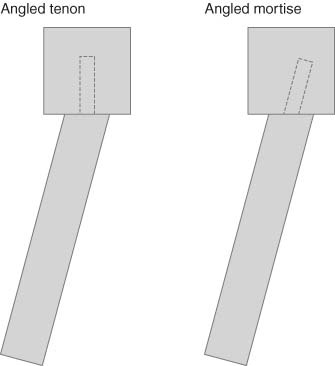
One of the great things about the shelf project, noted the Instructor, is the opportunity to carve many angled mortise-and-tenon joints. Could anything in the world sound more severely artisanal than that?!

http://www.dummies.com/how-to/content/tending-to-mortiseandtenon-joints.html

Tuesday, August 17, 2010

Is It a Closet or an Armoire?

At the end of our first class meeting, I introduced myself to the instructor with a question which was in fact too individual to be helpful to the entire class. Specifically, I asked, "How long do pine planks for wainscoting need to be acclimated to the room where they'll be installed?" (Conditioning, moisture, and acclimatization were major issues in the first lecture.)

As I walked up, though, he was telling a few other students to be thinking soon and seriously about their projects. As he turned to me, he observed my wedding ring and said, "You're married, you have nothing to worry about! Your wife will have plenty of ideas for you!"

Dropped in the Shop

At the end of our first lecture, after two or three long, awkward breaks in the long, mostly awkward presentation on the otherwise scintillating topic of lumber, our instructor informed us that we'd spend the remainder of the allotted time cleaning the workshop in preparation for the semester ahead.

He framed this with a tone familiar to summer campers and army recruits - the cleaning of the workshop being offered as a combination of orientation and hazing, at the end of which we would have not only a clean place to enjoy but a "sense of ownership" over its contents and condition.

Even if we'd had not hours but days to "clean" this workshop, we would hardly have made a dent in the mess. Piles of nails lay about in piles of sawdust. A tool cabinet's doors swung open giving glimpses of a heaping melange of squares, chisels, mallets, and even more nails. Boxes of nails tumbled off shelves, spilling yet more nails on table tops, stacks of broken rods and boards, and countless half-used bottles of wood glue. I was happy to have brought my work gloves for picking up fist-fulls of nails.